
The Chesapeake Bay Brock Environmental Center is located in Virginia Beach, Virginia and was completed in 2015. The facility is part of the Chesapeake Bay Foundation's lower bay programs, working with the community to solve complex environmental issues. Previous collaborations between the project architect, engineer and owner allowed for a more critical evaluation of the current design necessities. Key design decisions included reducing workstation size, an outdoor classroom and selection of optimal glazing. This team was able to tour other Living Building Challenge projects to receive inspiration and a deeper understanding of regenerative building.
SITE
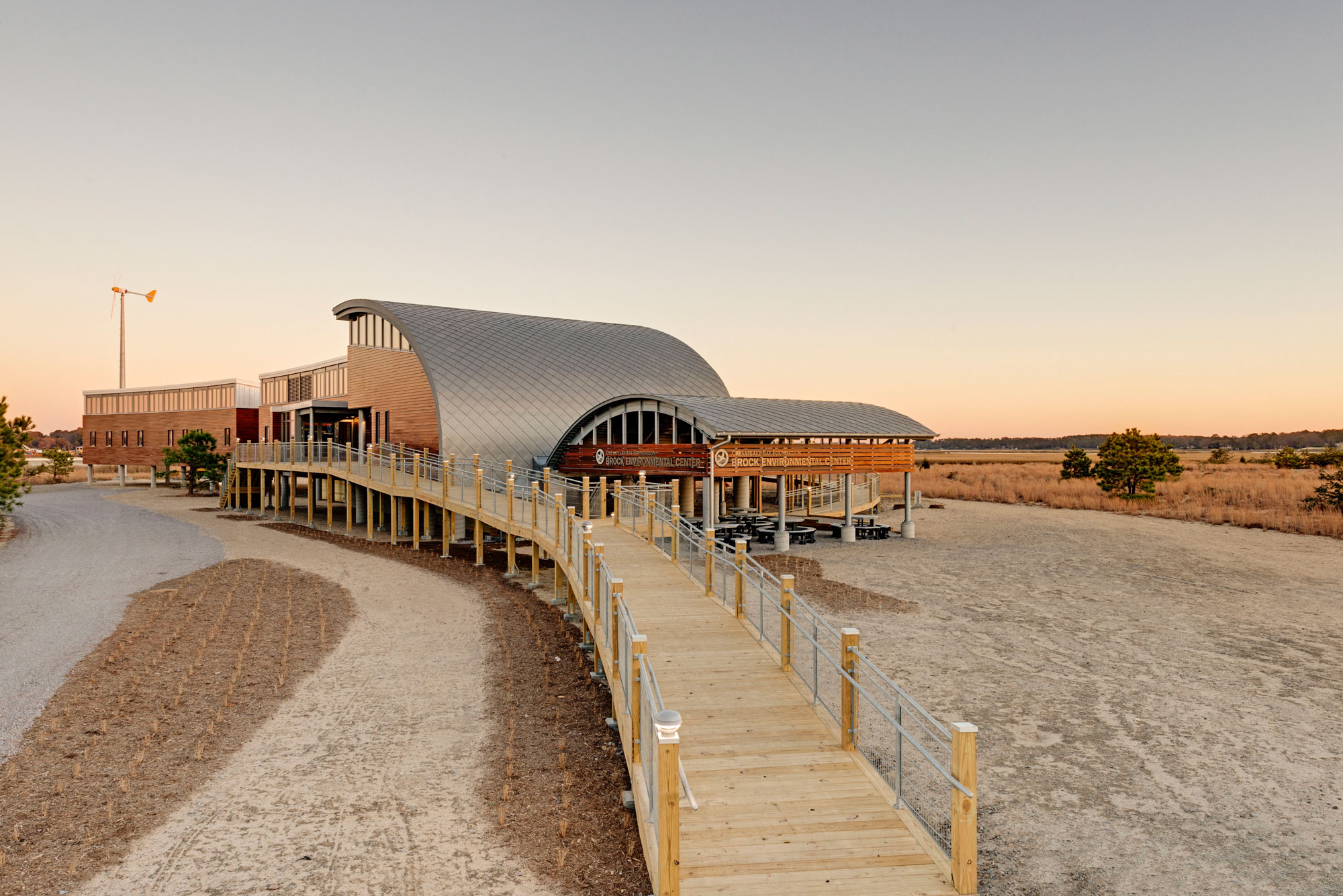
Through analysis of the site, it was discovered that it has potential for using wind as a renewable source. The Center for Wind Energy at James Madison University collaborated with the US Fish and Wildlife Services to create wind turbines that would be safe for animals. From the beginning of the project, analysis of stormwater management and collection of rainwater was considered. The Brock Center was sited to minimise the landscape impact and protect the surrounding maritime forest and wetlands.
The site is uniquely suited for an education centre, as it provides perfect opportunities to study the restoration of landscape and how land meets water. Restoration projects include: oyster protection, wetland rehabilitation, habitat restoration, water quality improvement, and shoreline restoration.
AGRICULTURE
Although the site is not conducive to typical agricultural practices, the centre encourages the planting of blackberries to provide food to wildlife. A pollinator garden was created and oysters were planted to provide filtering of water.
CAR FREE LIVING
There are only three parking spaces on site, and the building is connected by a wooded path to a nearby road. The City of Virginia Beach also provided community parking near the site, however no direct parking is available.
WATER
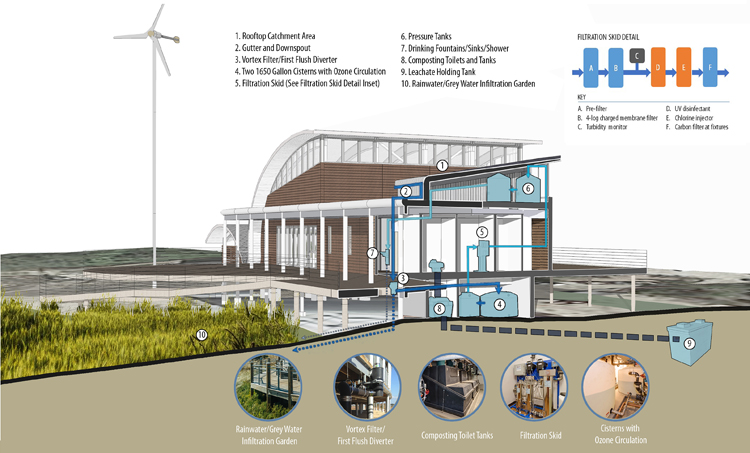
The Center is predicted to be net-zero water. Water demand calculations were performed in order to determine how this can be achieved. The overall design of the building includes water-saving plumbing, such as composting toilets, and low-flow fixtures. All landscaping does not require permanent irrigation, as it is native to the region. The largest difficulty is getting the regulatory approvals to allow treated rain to meet potable and non-potable water demands. Two standing seam metal roofs capture rainwater and fill two cisterns, where rainwater is then filtered and can supply all water uses to the Center. Greywater is piped to a rain-garden that is able to treat water. Excess roof runoff is diverted also to rain-gardens, allowing all water to be managed efficiently.
ENERGY
The Center was able to reduce its electricity consumption down to a Energy Use Intensity of 15.5. The roof and wall construction was modelled to determine the optimal R-value. A VRF system is used with geothermal wells. Photo sensor dimming-control system was used in all spaces to reduce the use of unnecessary lighting.
The wind-turbine system consists of two 10-kW turbines. They are located off the east and west ends of the building. The PV system designed originally used a total of 40kWp, and an additional 6.5 kWp was added.
HEALTH AND HAPPINESS
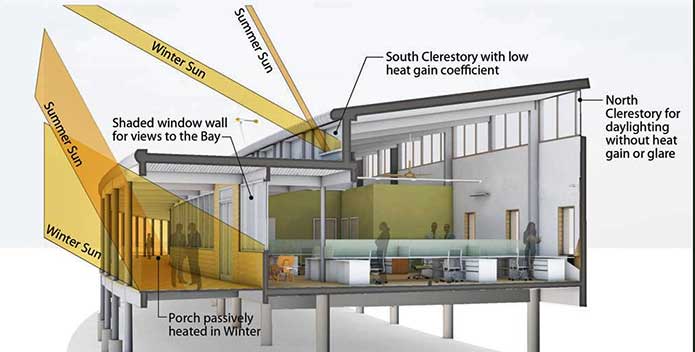
As the building is thin and narrow, following the curve of the beach, it allows for a large amount of daylight and ventilation. Many outdoor spaces are conducive to connection with nature, such as the education pavilion and overflow decks. Natural ventilation is also useful in cooling and temperature regulation, which was taken into consideration when designing window glazing size and location.
An HVAC system was also installed and air was tested before occupancy. All products and paints used were tested to be non-toxic for future occupants.
BIOPHILIA
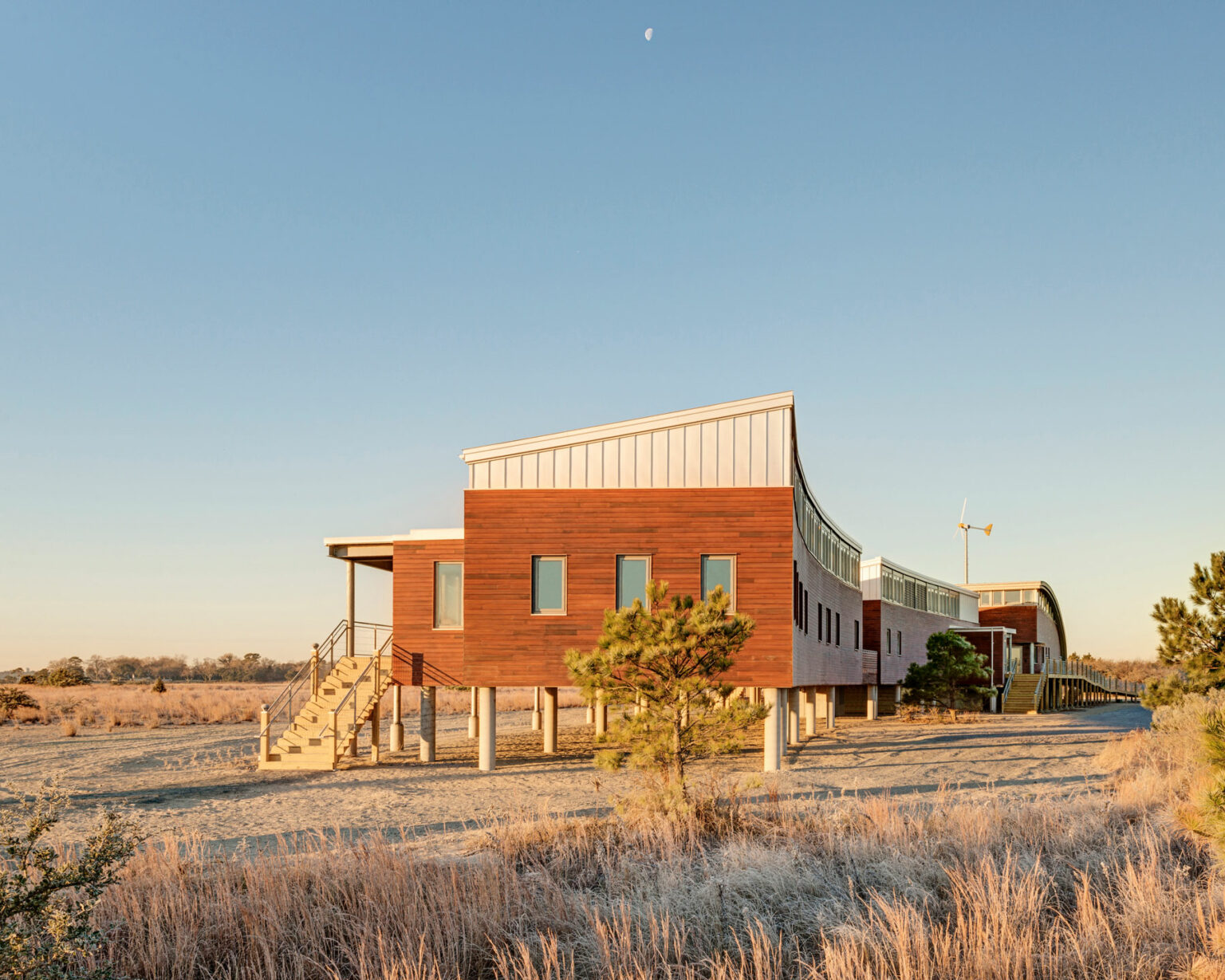
The Brock Center incorporates natural materials in all aspects of the design. Reclaimed cypress was used on the facade, and colours used in the interior were sampled from what was found on site. The building form, orientation and elevation allows for many shoreline vistas and connection to the exterior environment. The roof material, metal tiles, simulates fish scales.
The visitor arrival experience is inspired by the idea of exploration and discovery. The wooden path cuts through the maritime forest, and reveals the shoreline and Center as the ‘destination’ after the ‘journey’. The experience of the facility captures the idea of protection from the elements and nature’s forces.
MATERIALS
The overall strategy for materials was to focus on local, simple and uncomplicated materials. Another important aspect was durability. Firstly, individual spaces were reduced to their necessary sizes, without the need to over-build. In terms of structure, the embodied energy cost of concrete was weighed up against the durability needed on this coastal site. For the building skin, a tight and well-insulated envelope was needed in a windy location.
Construction waste was sorted and received a recovery rate of 95%, and the end of life was postponed as much as possible. In order to achieve net zero carbon, 1,234 metric tonnes of carbon offsets were purchased through Sterling Planet, supporting a Landfill Gas to Energy project in Dartmouth, Massachusetts.
Salvaged materials used:
- “All cabinets, countertops, mirrors, sinks, toilet accessories, lockers, etc. were salvaged from local demolition projects. Cabinet pulls were made from salvaged champagne corks, a reminder of happy occasions.
- The wood siding was milled from cypress “sinker logs”—remnants from 19th century logging, recovered from the bottom of rivers centuries later.
- All interior wood trim was made from salvaged bleachers, full of character where students’ carvings/graffiti were preserved.
- All wood doors were salvaged from local demolition projects. After struggling to find the correct size, a creative solution was found – the doors are trimmed top and bottom trim with the bleacher wood to add a few inches.
- Maple floors from a local gymnasium were transformed into interior flooring. The salvaged aspect of the gym flooring was highlighted by keeping a patch of unfinished flooring in one of the small telephone rooms. The flooring is in its “found” state, complete with a delightful random colourful pattern made from the shuffled stripes of the gym flooring. Adjacent to the finished product, it is a popular teachable moment on the building tours, as is all the salvaged wood.”
EQUITY
The Brock Center’s design is made at a human-scale. Access to the site is made with all community members in mind, and is a place for people, not for cars. It is a one-story facility, and respects the height limits of the adjacent community. Site conditions and paths were tested and designed to be completely accessible, with 8 foot wide walkways and ramps when necessary. As the centre is located far from adjoining properties, it does not shade or block any surrounding built structures. No fences or boundaries are present, to further cement the idea of universal access.
BEAUTY
Design choices were dictated not only by resource efficiency and passive design strategies, but also were centred around creating a beautiful area for people to experience. The curved elements of the Brock Center are a welcoming feature, as visitors approach from the forest. Overall the design recalls the nature around it, such as the multiple curving roofs and salvaged wood materials. These choices form an ideal platform for education of understanding the natural and built environment.