
INTRODUCTION
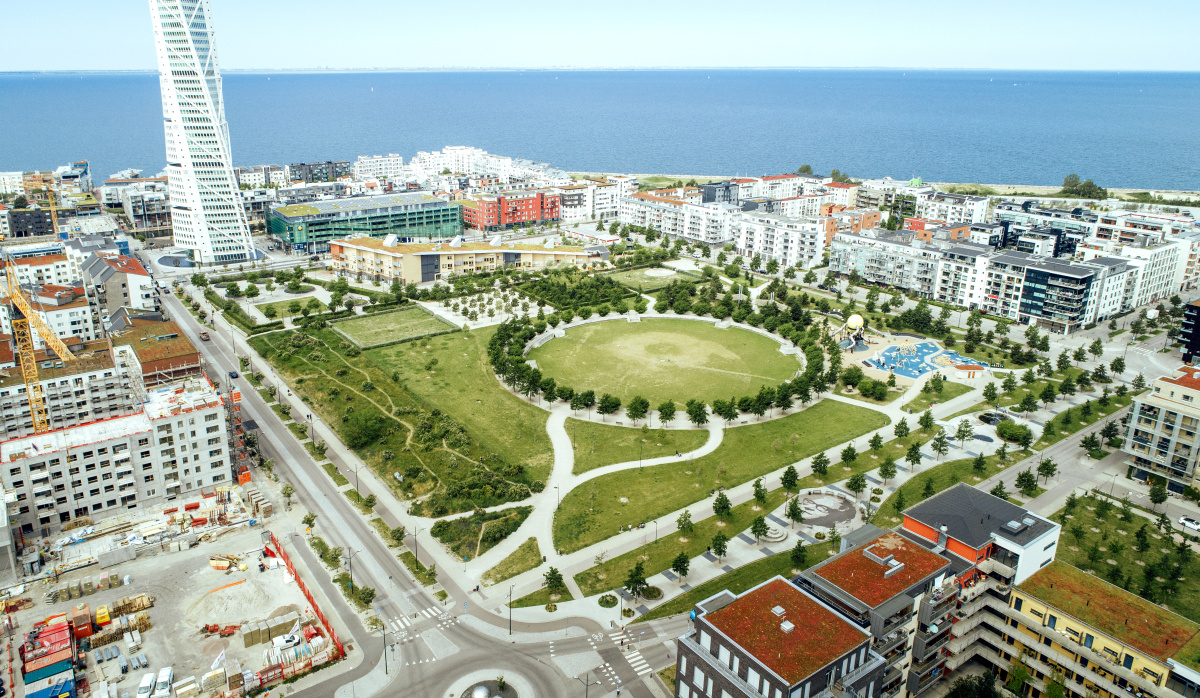
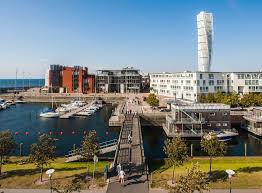
Västra Hamnen is a district in Malmo, Sweden that initially was an artificial port and shipyard. The idea of an expansion of the area was introduced at the European Housing Fair in 2001, along with innovative environmental solutions and urban development. Construction of the first stage began immediately in 2001, and the last construction projects are expected to be finished in 2035. In 2031, Västra Hamnen is expected to have 25,000 residents and the same amount of people working in the area.
 SUSTAINABLE LIVING
When beginning the project, the city of Malmo established guidelines for green environments, waste solutions and healthy indoor environments. One of these goals included stormwater management, which is dealt with on site. The water flows in open channels and adds to the biophilic urban surrounding. Green roofs are also featured on buildings to manage water. The homes are constructed very close together, however priority is given to public green land. Each housing estate is required to carry out at least ten environmental measures.
ENERGY
The entire built area is supplied by locally produced energy from renewable sources. Many homes have solar panels that provide heating and electricity. Some homes also have wind turbines, and the entire district utilises electricity from a wind turbine in Norra Hamnen.
WASTE
The district facilitates a cycle system to minimise waste and enables recycling. 147 apartments were given waste grinders in sinks, which were so successful that they were installed in 600 apartments. The food waste is collected in tanks and with garbage trucks, and is then converted into biogas. The biogas is responsible for powering Malmo’s city buses.
TRAVEL
By 2031, the goal of Västra Hamnen is for walking, cycling and public transportation to cover 75 percent of the residents’ trips, and 70 percent of trips to workplaces. The urban planning of the area facilitates the use of public transport, and makes the use of cars more difficult. Car pools are encouraged.
Overall, the district is a good example of sustainable urban construction, however it is still not fully developed and will be moving towards an even more sustainable future.