
The Bullitt Center is the product of the Bullitt Foundation’s vision to promote urban sustainability in Cascadia, the Northwest corner of the US and the Southwest corner of Canada, and is designed to show what’s possible, increasing the pace of change in the movement toward high performance green buildings and resilient cities. While the building includes many innovations, in reality every feature of the building is being used elsewhere in the world. As Denis Hayes says, “our chief innovation is that we brought all these ideas together in one place at the same time” – net zero energy and water, composting toilets, toxic-free materials, FSC wood, and more. The foundation is a tenant, occupying half of one floor in the six story building, with additional commercial tenants - including the University of Washington, Hammer & Hand, Sonos, Intentional Futures and PAE Consulting Engineers - occupying the rest of the building. The building is fully leased.
The Bullitt Center was designed to have a 250-year lifespan. In 2016, the Bullitt Center produced nearly 30 percent more energy than it needed for all uses, from the solar panels on its roof. As a result, it is one of the largest "net positive" energy buildings in the world. Energy is generated by a large solar panel array (composed of 575 panels) on the roof of the building, along with energy conservation measures that cut the building's energy consumption to approximately 15% of a typical office building of similar size. In 2016, the Bullitt Center had an energy use intensity (EUI) of 12, compared to an average commercial building in Seattle with an EUI of 90 or more. Although the building is connected to the electricity grid and at times draws more power than it produces (especially during the Seattle's cloudy winter), at other times it produces enough surplus energy to "repay" such withdrawals, yielding annual net positive energy.
Other features of the building include an onsite rainwater-to-potable water system, which will filter collected rainwater for all purposes once it is approved by regulators. There is also an onsite composting toilet system, the world's only 6-story system of its kind.
Considered to be at the current cutting edge of green construction, the structure requires a number of technical, legal, and social innovations to achieve a high level of ecological performance. The long-term, 250-year design of the building created financing challenges, as banks were unfamiliar with and thus hesitant to back such a project, because commercial buildings are typically financed based on an assumed 40-year lifespan. The 52,000 gallon rainwater collection and UV light purification system has run into challenges with public health regulations, which require that water for consumption be chlorinated. The owners are working to meet regulatory requirements, using ceramic filters and adding chlorine. The builders have negotiated with building material suppliers to ensure their products did not contain any of over 360 toxic chemicals; the supplier of the building sealant, for instance, agreed to remove phthalates from their product so that the building could use it. The structure also includes social design elements to reduce consumer energy use: the building may provide immediate feedback on energy use and publicize energy consumption via a real-time energy dashboard.
Additional features include 26 geothermal wells that extend 400 feet (120 m) into the ground, where the temperature is a constant 55 °F (13 °C). These wells help heat the building in the winter and cool it in summer. A heavy timber structure, all of the building's lumber is certified to standards set by the Forest Stewardship Council and it is the first commercial building in the U.S. to earn FSC Project Certification. Also, the building has no parking spaces—only bike racks.
The buildings elevators have intentionally been installed out of sight to encourage people to use the staircase which has been prominently placed protruding from the façade allowing for a good view of the surrounding area.
From Wikipedia and Bullitt Center web site
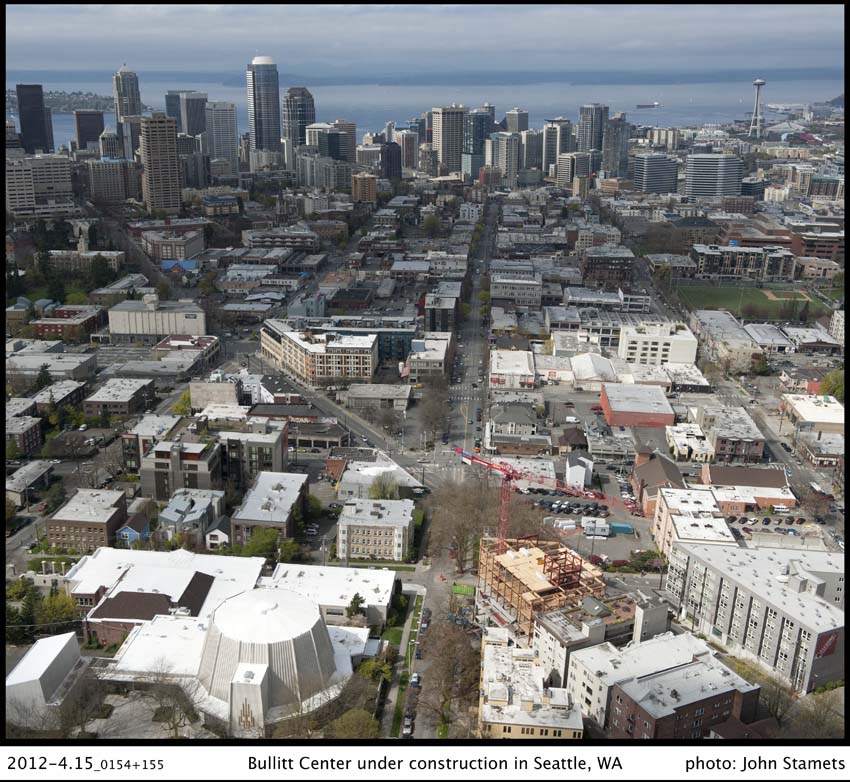
The Bullitt Center is a commercial office building at the intersection of the Central District neighborhood, and Capitol Hill, Seattle, Washington. It was officially opened on Earth Day, April 22, 2013 and was designed to be the greenest commercial building in the world, being certified as a "Living Building" by the International Living Future Institute in April 2015.
Construction costs for the six-story, 52,000-square-foot (4,800 m2) building were $18.5 million, or $355 per square foot. Including land and soft costs, the cost is $32.5 million. For this price the building provided "tenant ready" space (as opposed to the typical "cold dark shell" that most commercial spaces deliver).
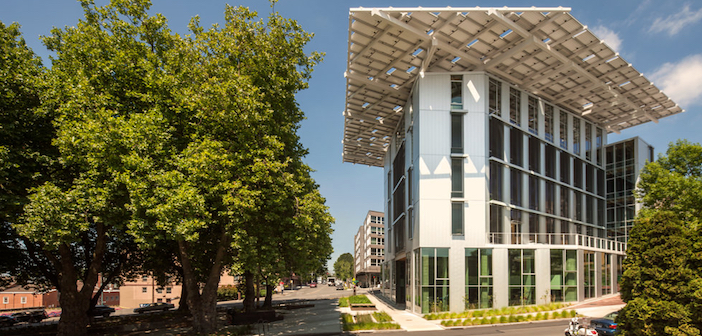
Four years after its completion, the Bullitt Center in Seattle may have lost its title as the world's most sustainable office building. However, the implemented solutions, which enabled it to achieve the Living Building Challenge certification, remain relevant and highly valuable. They continue to demonstrate and teach that green building is achievable.
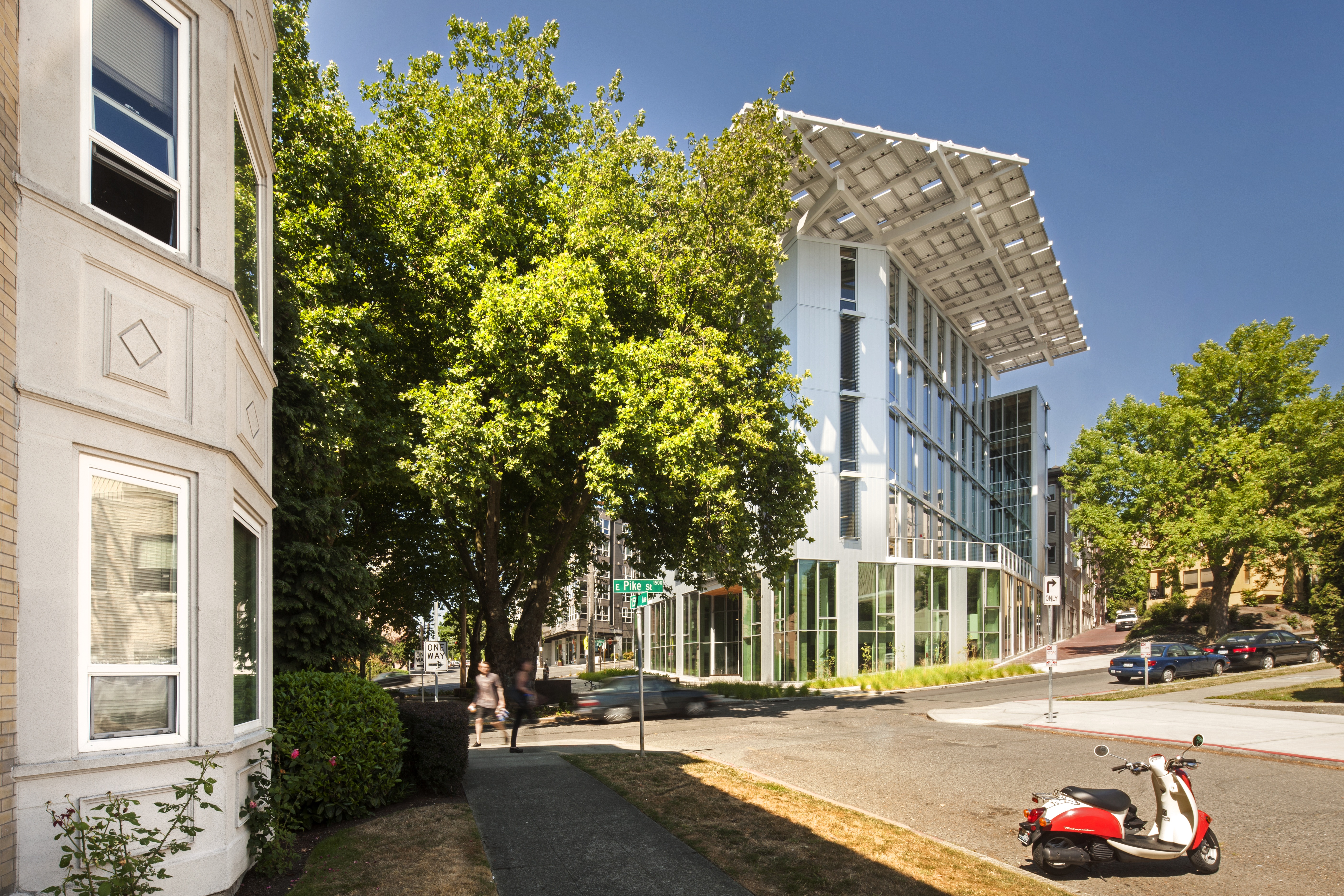
McGilvra Place Park is a .5 acre public space on the edge of Seattle’s Central District adjacent to the Bullitt Center. It also has the distinction of being the first project to pursue the Living Building Challenge for the Infrastructure + Landscape Typology.
Once a forgotten traffic median on a major city arterial, the project is now an activated and enlivened pocket park in an area that specifically calls for more green space in its neighborhood plans.
During the redevelopment of McGilvra Place, great care was taken to protect and celebrate eleven century-old London Plane trees on the site. Other improvements include transforming an adjacent street to a public plaza, replacing turf with native vegetation, installing park furniture made of reclaimed timber, and providing improved accessibility to the site. Construction began in February 2013 and was completed in April 2013.
The project was undertaken through a public / private collaboration between Seattle Department of Parks and Recreation, Seattle Department of Transportation, Seattle Parks Foundation and the Bullitt Foundation.
In conjunction with the development of the Bullitt Center, a neighborhood group was formed to submit an application to the Seattle Parks and Green Spaces Levy Opportunity Fund. Due in large part to the innovative sustainability objectives of the project, it was awarded funding in late 2010. The Bullitt Foundation and the Seattle Parks Foundation led a capital campaign to collect the remaining funds needed to transform this deltoid-shaped urban traffic median into a community park.
The Berger Partnership worked with Seattle Department of Parks and Recreation on the project design, with Springline Design providing civil engineering services. WS Contractors completed the work.
Environmentally friendly features of the project include the following:
- Avoids the use of Red-List materials
- Diversion of construction waste from landfill
- Replaced turf with native plant species that require no irrigation
- Reduces stormwater run-off that enters Lake Union via the separated storm line
- Presentation of drought tolerant plant species at McGilvra
Community benefits of the project include the following:
- Creates a new neighborhood gathering space as recommended by neighborhood plans.
- Improves safety for pedestrians and bicyclists by eliminating motor vehicle access on 15th Avenue between East Madison and East Pike Streets.
- Includes benches, a pedestrian plaza and a ping pong table to activate the site.
- Serves as a new model for public-private partnership for management, without increasing public-sector operating costs.
- Developed in partnership with neighbors, the City of Seattle and the Seattle Parks Foundation.
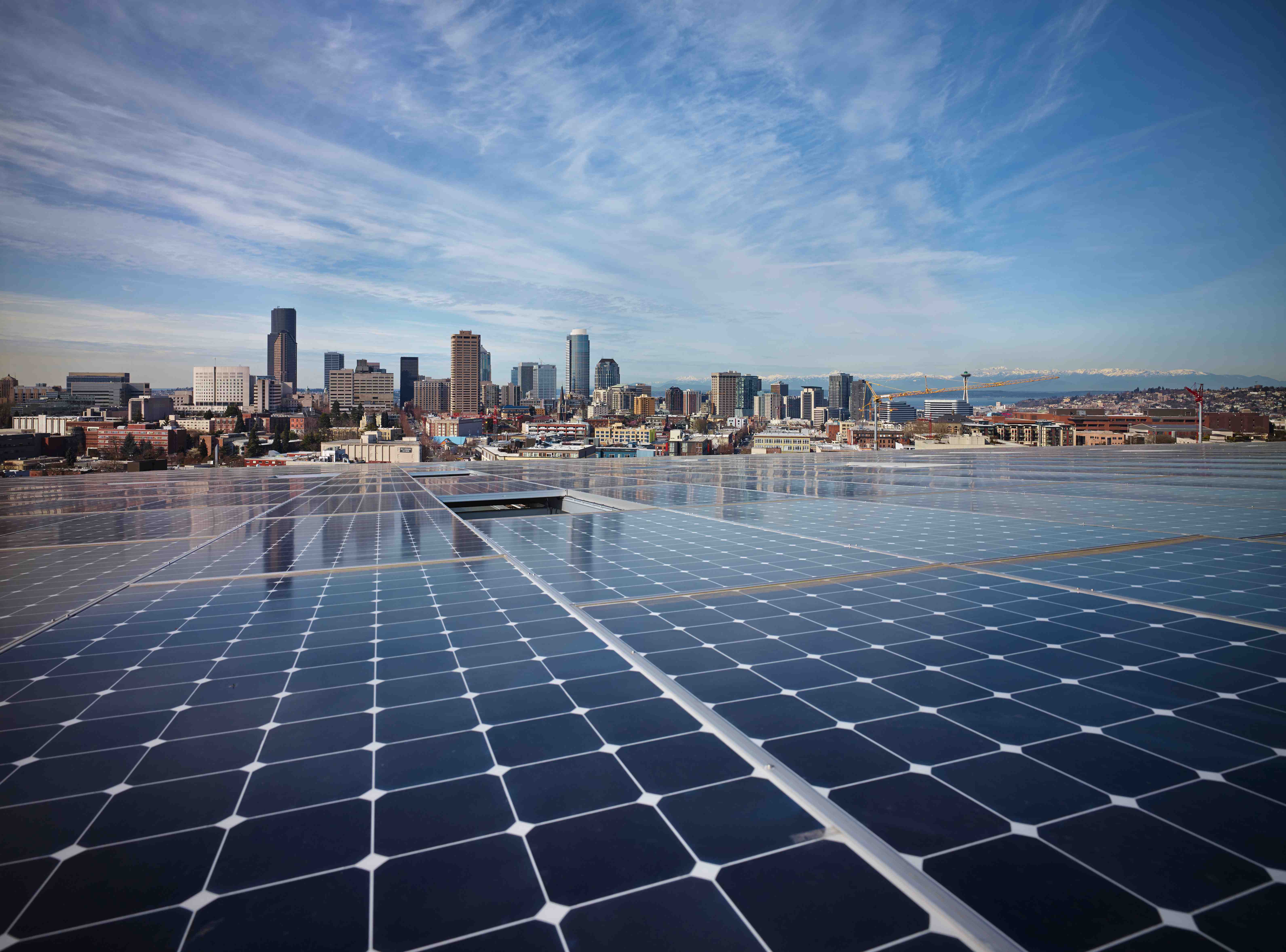
Net zero energy is possible, even in Seattle.
- 575 solar panels generate more energy than the building uses in a year.
- One meter measures energy sold to electric utility, one measures energy purchased.
- 230,000 kilowatt hours per year is the expected total energy generation by on-site photovoltaic array.
To be certified as a Living Building, the Bullitt Center must annually produce as much electricity as it uses. To achieve this goal, the Bullitt Center has 575 solar panels on the roof, creating a 14,000 square-foot array to generate electricity.
The panels are sensitive to the amount of daylight they receive, meaning that production values are closely related to solar intensity and sky conditions. In the summer, the Bullitt Center will produce vastly more electricity than it uses, and in the winter it will produce less.
Normally panels are set to face south, at the angle of the latitude so that they can collect sun in the winter. However, the designers realized that in Seattle, most of the sun is received in the summer, and the shallow-angled winter sun would not provide much benefit behind the blanket of clouds that shrouds our fair city during winter. The decision was made to optimize for summer, using the electrical grid as a battery to store power in the summer, and draw power from in the winter. The Bullitt Center energy budget shows how the summer surplus can offset a winter deficit.
In order to “store” the summer’s surplus, the Bullitt Center uses Seattle’s electrical grid, pushing electricity onto the grid in the summer months when production is high (and when Seattle’s demand is at its highest). The building then takes electricity from the grid in the winter months when production is low. To achieve its “net zero energy” goal, the summer production surplus must meet or exceed the winter production deficit.
Two electricity meters live in the core of the Bullitt Center, carefully monitored by Seattle City Light and the Bullitt Center building engineer. One spins clockwise for the amount of energy the Bullitt Center is pulling from the grid, the other spins counter-clockwise and counts how much energy the Bullitt Center is pushing back onto the grid.
The second part of the net-zero energy equation is the energy consumption of the building. A typical office building operates at 92 EUI (Energy Use Intensity, which is comparable to miles per gallon in a car). If the Bullitt Center had an EUI of 92, it would have needed an 82,000 square-foot solar array on the roof to generate all of its energy from the sun.
Instead, with the integration of energy saving systems, such as passive ventilation, ground source heat pump, and natural daylighting, along with the help of tenant energy budgets, the Bullitt Center will be able to operate at an EUI of 16. With such a small EUI, the 14,000 square foot rooftop array is able to provide for all the electrical needs of the building.

The visionary Bullitt Foundation commissioned the world’s first mid-rise commercial building and public open space to meet the Living Building Challenge. The Bullitt Center and adjacent McGilvra Place Park now serve as a model for building and exhibiting innovative and ecologically sensitive design and green infrastructure. To achieve Net Zero Water engineers and landscape architects created an innovative water system that loops rainwater catchment and wastewater disposal into onsite constructed wetlands and rain gardens to store, purify and recharge water to the landscape. The plant palette provides a softened foreground to the building structure while working hard to cleanse and manage stormwater, thrive in the urban environment, and express how urban ecology is integral to supporting the building’s systems. A native plant palette bridges the functional benefits for the landscape while recalling the site’s original landscape.
RAINWATER HARVESTING
Like a Doug fir forest, the Bullitt Center re-uses water and returns excess to the soil.
- 100% of the water used in the Bullitt Center comes from captured rainwater.
- Greywater is treated and re-used in the vacuum-flush toilet system. Excess greywater is returned to the soil to help recharge the aquifer.
The Bullitt Center is designed to help restore the ecological processes of the site back to they way they functioned hundreds of years ago when it was a Douglas fir forest.
Like a forest, the Bullitt Center must use only the water it can collect onsite.
Below the solar panels, a parapet roof captures rainwater and brings it to downspouts that carry the water to a 56,000-gallon, concrete cistern in the basement. On its way down, the water is funneled through a vortex filter, which removes large particulates. Next to the cistern is a “day-use tank” that holds 500 gallons of clean, potable water. To create the potable water, the rainwater is filtered through ceramic filters before being passed under ultraviolet light; a small amount of chlorine is added at the end.
REYWATER SYSTEM COLLECTION & RE-USE
The project re-uses greywater and infiltrates it back into the ground.
- Water from sinks and showers is stored in a 550-gallon greywater tank, treated in a three-stage filtration process, and re-used in the vacuum-flush toilet system.
- The greywater system was updated when the composting toilet system was replaced with a vacuum-flush system in 2021.
Denis Hayes, the leader behind the Bullitt Center, often compares the building to the Douglas fir forest that once covered the site before settlement by Europeans. With respect to water, the forest would retain, metabolize, and then slowly release the water that falls on its site.
When the composting toilet system was in use (2013-2020), greywater was used solely to recharge the aquifer under the building. With the introduction of a vacuum-flush toilet system, greywater is now treated and used to flush toilets. Greywater is also diverted into the constructed wetland on the third level before being infiltrated into the ground to help recharge the aquifer.
Before greywater is used to flush toilets, it is treated in a three-stage filtration process, followed by a two-stage ultra-violet light disinfection process. The vacuum-flush toilet system uses .4 gallons of treated greywater per flush, which is 70% less water than the average flush toilet.
For greywater diverted to the constructed wetland, it passes through layers of porous gravels and soils. Horsetails, or equisetum, are used as the primary plant for their hardiness and ability to thrive in Seattle’s climate. The water is pumped through a series of drip lines so that the plants can absorb the nutrients. It is then collected and pumped through the system several more times until the nutrients have been absorbed and it is safe to release in the bio-swales along the western edge of the site.
In the bio-swales, the water filters down through 20 feet of gravel before it is deposited into the water table. Functioning similar to the Douglas fir forest, this catch and slow release of water allows the Bullitt Center to restore 61% of the water to the ecosystem either through ground infiltration or evaporation, and mitigate stormwater during and after rain events.
VACUUM TOILETS
Highly efficient vacuum system.
- After 7 years of operation, the composting toilet system was removed in 2021.
- The vacuum system uses 70% less water than a standard flush toilet.
After seven years, the Bullitt Center removed its innovative composting system and replaced it with a vacuum flush system.
The vacuum flush system is highly efficient, using just .4 gallons of treated greywater per flush. The vacuum pumps pull waste through a grinder to eliminate problematic solids before moving them into a collection tank. From the collection tank, waste goes into the King County sanitary sewer for treatment. Like in the composting system, solids from the sewage treatment plant are converted into a human “bio-solid” called “Loop,” which can be used as a fertilizer.